The Issue: a “Low Carbon Fuel Standard” or “Clean Fuel Standard” in Minnesota = California-style fuel prices.
Politicians in St. Paul are pushing a fuel policy that would increase prices at the pump, meaning Minnesotans would have to pay more for everything from gas to toilet paper.
It's called a "Low Carbon Fuel Standard" (LCFS), and in Minnesota, lawmakers are branding it the "Clean Transportation Standard" (CTS).
The name sounds reasonable. The reality is not.
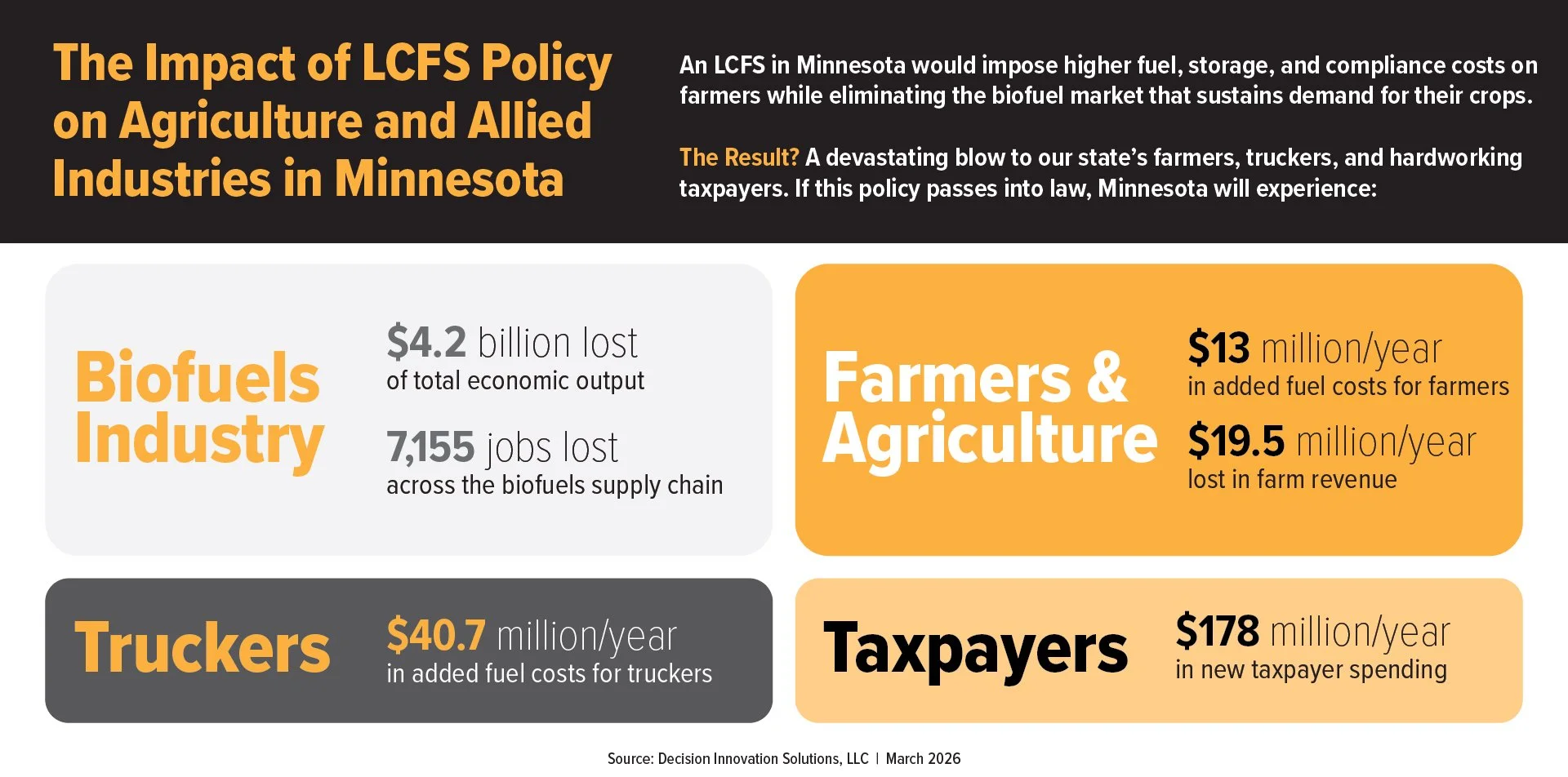
According to a 2026 study, the projected losses for Minnesota under an LCFS are severe:
In the biofuels industry, this will lead to:
$1.1 billion in lost value across the state economy
$4.2 billion in economic activity gone
7,155 Minnesotans out of work
$520 million in lost wages and income
For our farmers:
$13 million/year in added fuel costs
$19.3 million/year in lost farm revenue
For our truckers:
$40.7 million/year in added fuel costs
For us taxpayers:
$178 million/year in new taxpayer spending
Here's how it works:
An LCFS sets an ever-tightening "carbon intensity" score that all transportation fuels must meet.
Each year, the bar moves. Gasoline, diesel, propane, and even ethanol and biofuels get progressively penalized with fees and mandates until they become economically unviable or outright prohibited.
The only fuels that consistently "pass" the test over time are electricity and a narrow set of alternatives.
In plain terms: the government slowly removes your choice to buy the car that is best for your family. It's rigging the market so that, year by year, liquid fuels are taxed and squeezed out of existence while electric vehicle (EV) infrastructure is subsidized in their place.
This is an EV mandate written so that most people won't realize it until it is too late.
The short-term result is higher fuel costs for every Minnesotan who drives a gas or diesel vehicle, which is nearly all of us. The damage does not stop at the pump, though. Fuel costs are embedded in the price of everything. Over 70% of food in the U.S. travels by diesel truck before it reaches a grocery store shelf. When diesel gets more expensive, groceries get more expensive. Research shows that a 10% increase in diesel prices translates to a measurable rise in food costs. An LCFS doesn't just raise what you pay to fill up. It raises what you pay for everything.
The long-term goal of this program and its end result are a forced transition away from every liquid fuel that Minnesotans depend on: gasoline, diesel, ethanol, biodiesel, and the homegrown biofuels that support Minnesota's farm economy.
At a time when Minnesotans are asking policymakers to address the rising cost of living, adopting a policy designed to raise fuel prices and make us dip into our wallets to buy unnecessary, higher-priced fuels or transition to a costly electric vehicle would move the state in exactly the wrong direction.
California has operated an LCFS since 2011. The outcome? Some of the highest fuel prices in the nation, a mandate-driven EV market propped up by billions in subsidies, and energy costs that continue to squeeze working families and small businesses. Minnesota politicians are now trying to import that same framework into our state with brutal winters, vast rural distances, and an agricultural economy that depends on heavy equipment that no battery can power reliably.
Minnesota is not California. Our terrain, our climate, and our economy demand real choices instead of a government-engineered countdown to a single mandated option. Yet if this legislation passes, that's exactly what Minnesotans will get: steadily rising fuel costs to conform our state's energy policy to a California model that was never designed with Minnesota in mind.
The politicians pushing this tell us it won't raise your fuel prices. But you don’t need to take our word for it; look at every state that has adopted a similar policy, and they have the most expensive gas prices in the U.S., and by a wide margin.

Impact on Affordability: Higher Prices Everywhere for Every Minnesotan
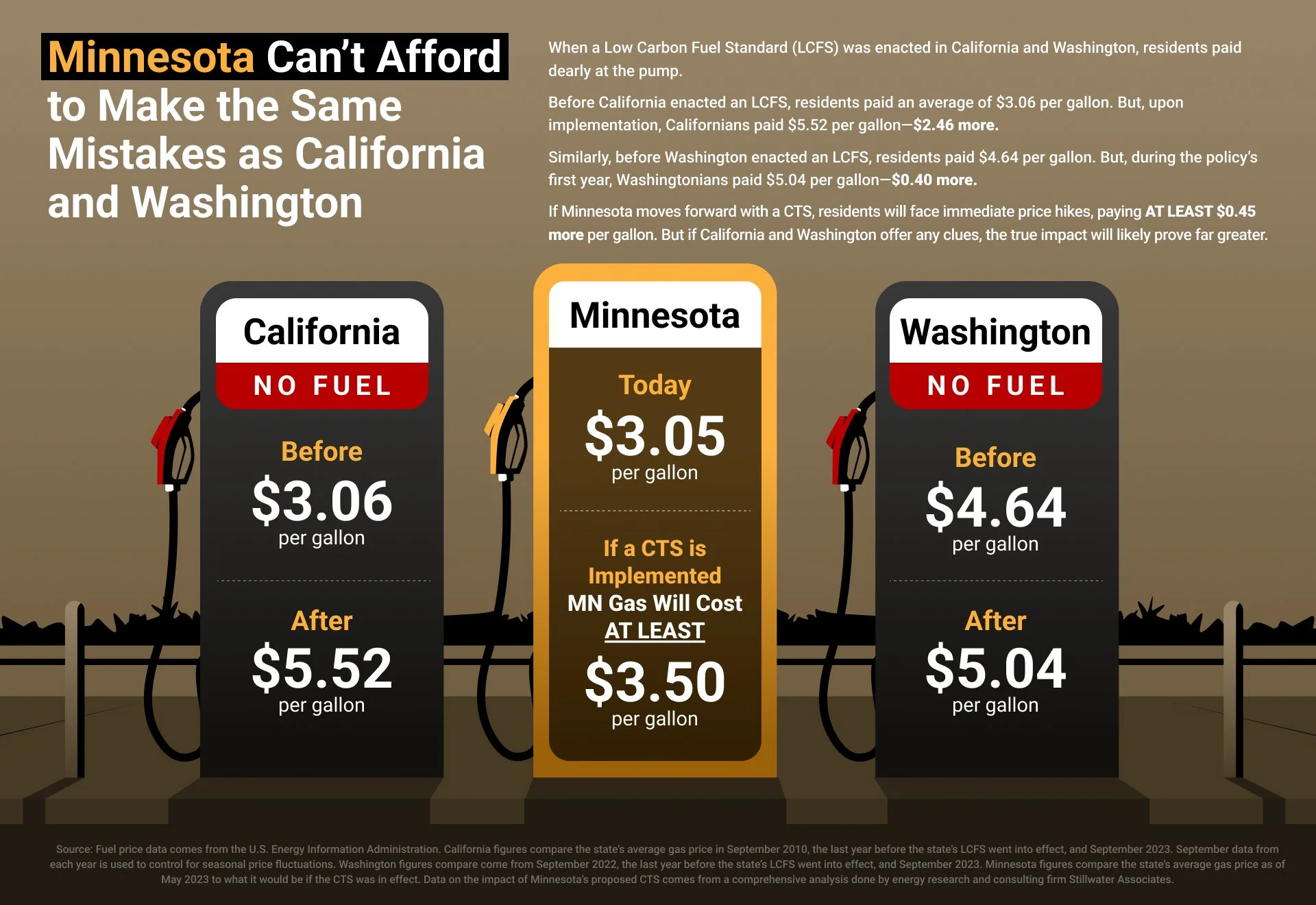
$3.61 more per gallon of diesel. $1.00 or more per gallon of gas. That's not a worst-case scenario under an LCFS; that's what environmentalists themselves are projecting under the Clean Transportation Standard. When a “CTS” raises prices on all fuel in Minnesota, it threatens not only what Minnesotans pay at the pump but also the thousands of agricultural jobs and family farms across the state that depend on domestic energy. It would also force Minnesotans to subsidize electric vehicles and expensive fuels produced in other states.
Who absorbs these costs most directly?
The father driving 40 miles to work on a rural highway.
The farmer running a diesel combine through an October harvest.
The small trucking company moving goods across the Iron Range.
The single mom choosing between a full tank and a full fridge.
These are the Minnesotans, who already spend a larger share of their budgets on essentials like fuel and transportation, this policy punishes most, and they're the ones who will be forced to make the impossible choices between filling the tank, buying groceries, or keeping the lights on if this government-engineered price hike passes into law.
In practice, this policy shifts the burden of the energy transition onto the very households least able to afford it.
It is impossible to support Minnesota fuel producers, including workers in the state’s biofuels and agricultural sectors, while also embracing policies that price these fuels out of the market.
It is impossible to stand with Minnesota families while pushing policies that will hit them in their pocketbooks and upend their daily lives.

Who’s Trying to Ban Fuels & Vehicles?
Some lawmakers in St. Paul have been pushing to adopt a California-style fuel mandate for years, but their efforts have largely failed due to the unacceptably high cost it would impose on Minnesota families.
At the end of its 2023 session, however, the Minnesota Legislature quietly created a “Work Group” to study a CTS and provide recommendations for its implementation. The Work Group was tasked with an extremely narrow scope, focusing exclusively on how the state could go about implementing the policy. It has not examined larger, more substantive questions about how quickly this CTS becomes a fuel ban, how much a fuel ban will cost consumers, what impact it will have on Minnesota’s existing fuel industry, or if such a policy is even feasible in Minnesota to begin with.
The Work Group’s own analysis shows that simply sticking with current Minnesota policies—which would impose no additional costs on Minnesota families—would achieve a 30 percent reduction in the state’s transportation sector emissions. However, if the fuel mandate policy does move forward, Minnesota families could be forced to pay hundreds of dollars more yearly in fuel costs to subsidize electric vehicles and fuels produced in other states.
The Work Group submitted its report to the legislature on February 1, 2024. Ahead of a vote on the fuel ban, lawmakers faced widespread outrage from engaged constituents and various groups in key sectors, many of them members of the No Fuel Ban Coalition. To the relief of all Minnesotans, efforts to enact a fuel ban were ultimately defeated.
While lawmakers chose not to move forward with a fuel ban during last year’s session, that did not stop them from trying again this year. There is grave concern among Minnesotans that proponents will try to push similar, misguided legislation next year and beyond until they win.

Has a CTS Been Tried Before?
If Minnesota moves ahead with the fuel ban, it would be the fifth state to implement the policy, joining California, Oregon, Washington, and New Mexico.
All four states that have implemented this ban boast the highest gas prices in the nation, exacerbating the affordability crisis already plaguing their citizens.
Proponents passed these policies on the promise that they would eventually lower costs in the long term through innovation and alternative fuels, but after more than a decade of experience in these states, the real-world result has been higher fuel prices and higher transportation costs for consumers.
California’s policy has contributed to the highest fuel prices in the nation, with minimal environmental impact. The Environmental Work Group’s (who are pushing for the LCFS) own analysis shows Minnesota will lower transportation emissions by 30 percent under existing policies.
Despite significant harm, California recently strengthened its fuel mandate policies, including many changes similar to what Minnesota lawmakers are considering. The California Air Resources Board projects the Minnesota-style change would increase gas prices by an additional $0.37 per gallon immediately, and more than $1.50 per gallon later. Diesel prices would rise by roughly $0.50 per gallon in the first few years, exceeding $2.00 per gallon long-term.
These fuel mandate policies inflate prices and ripple through the economy, kneecapping job markets. In California, they forced seven oil refineries to shutter, costing thousands of jobs, and even Governor Gavin Newsom worries about the consequences. With only two refineries, Minnesota could see out-of-touch St. Paul mandates decimate fuel production and swiftly put thousands out of work.
Washington’s policy increased fuel prices up to 50 TIMES MORE than advocates predicted. The Department of Ecology forecasted less than $0.01 impact in 2023, but consumers paid up to $0.50 more per gallon at peak, per the Oil Price Information Service.
Washington touts its Clean Fuel Standard as a model, but it only models how to raise costs on families and worsen the cost-of-living crisis. It ignores rural economies, agriculture, and lower-income residents, acting as an impractical, unaffordable EV mandate for many Americans.
These states have chosen to go down the path of higher prices and fewer options. Far from improving affordability, these policies have repeatedly made everyday transportation more expensive for the very people who rely on it most.
If new fuel standard proponents in Minnesota get their way, families, small businesses, and hardworking Americans will be devastated.
The choice is clear: Politicians can support Minnesota families or higher prices—not both.
Questions to Consider
Inflation has already placed a burden on countless Minnesotans. How much more will bans on fuels and vehicles cost families?
Minnesota—along with our farmers, employers, and workers—has heavily invested in biofuels, liquid fuel production, and agriculture. How many of these jobs will a California-style fuel ban destroy?
Minnesota’s winters and terrain pose challenges that states like California do not experience, including harsh winters and heavy farm equipment. Are fuel and vehicle bans feasible in Minnesota?
Proponents of electric vehicles act as if the cost of “fueling” them is more affordable and efficient, but European nations have seen their charging rates skyrocket. States like California have had to prohibit drivers from plugging vehicles in at certain times of day to avoid blackouts. Existing infrastructure is simply not designed to support a huge influx of charging stations, and upgrading it would be expensive. Is the potential for such burdens worth the cost and safety of Minnesotans?

A Common-Sense Approach in Minnesota
The No Fuel Ban Coalition supports maintaining a high quality of life in Minnesota by protecting policies that keep energy reliable and affordable for the families, workers, and businesses that power Minnesota’s economy.
We support an all-of-the-above approach to energy. This includes energy policies that, for example, focus on clean and available biofuels that support thousands of jobs across Minnesota. It includes supporting consumer choice – not allowing government to force consumers into choosing vehicles through bans, mandates, or inefficient subsidies.
Our coalition brings together Minnesota’s agricultural leaders, labor voices, and supply chain stakeholders to ensure that any legislative or rulemaking activity on a Clean Transportation Standard program doesn’t jeopardize the advancement of an all-of-the-above energy portfolio for the state.
Minnesota’s farmers, truckers, manufacturers, and commuters depend on dependable and reasonably priced fuel to do their jobs and support their families. Policies that deliberately raise fuel prices threaten that stability and make it harder for businesses to operate and grow in our state.
Unfortunately, the Minnesota Legislature remains interested in entertaining these detrimental new fuel policies. It’s important that policymakers and Minnesotans understand the significance of this policy and conduct an appropriate fact-based analysis of the costs and benefits before passing California-style policy. California policies will produce California results. In this case, that means much higher fuel prices and little else.
While the No Fuel Ban Coalition does not call for the election or defeat of any candidate for any office, we believe citizens should know where their elected officials and candidates for office stand on these critical issues.
Sign our petition to Governor Walz and Legislative Leaders telling them to abandon the fuel ban idea and to let Minnesotans choose what kind of vehicle they want to drive.
In the News:
California Globe: Memo to Other States: Don’t Copy California on $6+ Gas
Daily Caller: "Clean Transportation" Insanity Must Stop In Minnesota
KTOE Radio: The Morning Blend, No Fuel Ban Effort in Minnesota
WWTC 1209AM The Patriot Radio: Liquid Fuel Ban
KMHL Radio: Marshall Radio News, No Fuel Ban Effort in Minnesota
MinnPost: A year later, legislation that would phase out traditional transportation fuels is still a bad idea
MinnPost: The clean transportation bill’s hidden tax hike
Competitive Enterprise Institute: Fueling discontent: Minnesota’s costly push for a low carbon fuel standard
Duluth News Tribune: Our View: Don't ignore warnings of 'backdoor gas tax hike' in Minnesota
Duluth News Tribune: Local View: Say no to Minnesota measure to ban all gasoline, diesel
Star Tribune: Farmers, gas stations sue Gov. Tim Walz over Minnesota 'clean car' rule